

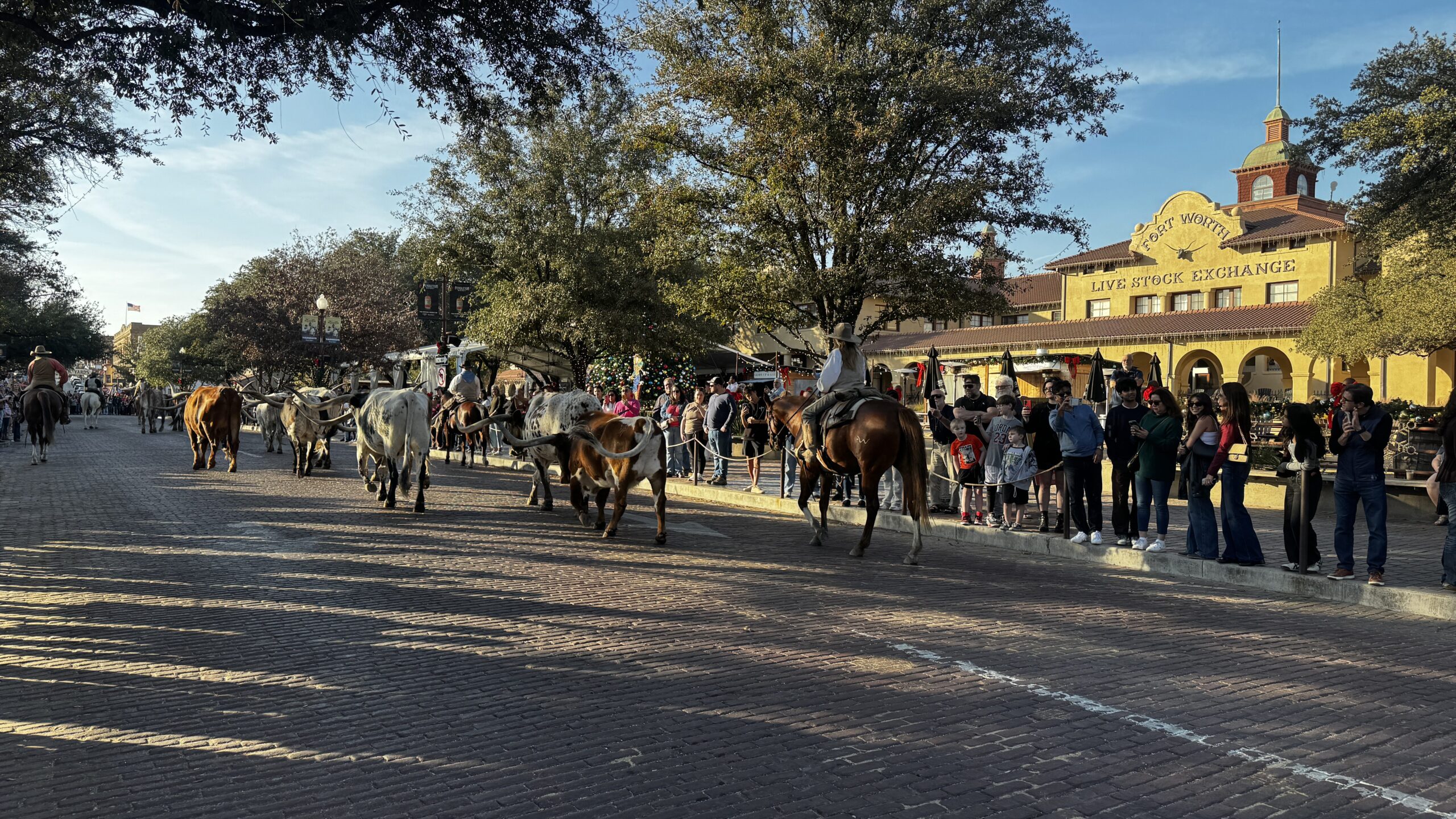
Every morning and afternoon, a small herd of Texas longhorns moves down East Exchange Avenue in Fort Worth, past brick warehouses and visitors holding up smartphones. The cattle drive lasts about 15 minutes. The economic story behind it took more than a century to build.
Today, the Fort Worth Stockyards attract roughly 11 million visitors a year, making them one of Texas’s busiest heritage districts. Beneath the cowboy hats lies a deeper history: this square mile was once one of the most sophisticated livestock markets in the world.something much deeper.
A Frontier Town Finds Its Footing
Fort Worth’s commercial destiny shifted in 1876 when the Texas & Pacific Railway arrived. What had been a modest Army outpost and final stop on the Chisholm Trail became a permanent trading hub connected to national markets. Between 1866 and 1890, more than 4 million head of livestock passed through the city en route to Kansas railheads, earning it the literal nickname “Cowtown.”
Rail access made larger infrastructure possible. In 1887, the city established the Union Stockyards two and a half miles north of the Tarrant County Courthouse. The 206-acre facility opened on January 19, 1890. Early financial strain ended in 1893 when Boston financier Greenleaf W. Simpson purchased the operation for roughly $133,333 and reorganized it as the Fort Worth Stockyards Company.
Simpson and his partners quickly realized that shipping live cattle elsewhere for processing forfeited profit. Their solution was vertical integration: bring the packers to Fort Worth.
The Coin Toss That Built an Industry
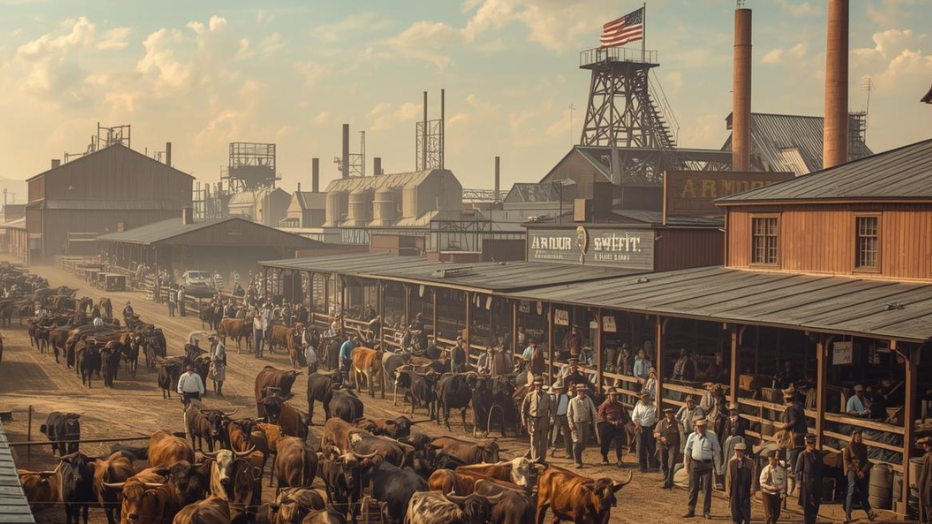
By 1900, two of the nation’s largest meatpackers —Armour & Co. and Swift & Co. — committed to building plants adjacent to the yards. A coin toss resolved a land dispute: Armour claimed the northern site; Swift took the southern tract and later sold gravel from its land to help finance construction. Both plants broke ground in 1902.
The economic impact was immediate. Fort Worth’s population tripled within a decade. Immigrant labor fueled plant operations, and North Fort Worth incorporated in 1902. By 1907, the Stockyards were selling a million cattle annually. By 1906, Fort Worth’s calf market ranked second only to Chicago. During World War I, the yards became the world’s largest horse and mule market. Within a half-square mile, a $30 million stockyard and meatpacking complex had formed.
More Than a Market: A Financial Architecture
The Stockyards operated less like a pen and more like a commodities exchange. Inside the Livestock Exchange Building, railroad agents, telegraph operators, commission firms, banks, and insurers coordinated daily transactions. Price signals set in Fort Worth influenced beef markets as far as Chicago and London. Futures contracts stabilized ranchers’ incomes, while financial institutions underwrote seasonal risk.
What made the model powerful was its concentration. Producers, processors, financiers, insurers, and distributors operated within a single geographic cluster. This dense ecosystem lowered transaction costs and accelerated the flow of goods, capital, and information — a structure later mirrored by industrial giants and modern platform companies alike.
Infrastructure created leverage. By controlling a critical rail intersection, Fort Worth became the unavoidable bottleneck of the cattle trade. And whoever controls the bottleneck captures the margin.
Peak, Decline, and Transition
The Stockyards reached their peak during World War II. In 1944, more than 5 million head of livestock were processed — the highest volume in its history. But postwar highways shifted trade to trucks, and smaller regional auctions began siphoning business away from centralized yards.
By the 1950s, annual receipts had fallen to about 2 million animals. Armour closed in 1962; Swift followed in 1971. By the time the district was designated a National Historic District in 1976, large-scale livestock operations had effectively ended. In 1986, sales hit an all-time low of just 57,181 animals.
Reinvention: Heritage as the New Commodity
The Stockyards’ second life began with preservation. Restoration of the Livestock Exchange Building, Cowtown Coliseum, and historic structures gradually repositioned the district as a heritage destination.
The modern acceleration came with a roughly $500 million redevelopment led by Majestic Realty’s Stockyards Heritage Development Co. Phase one — about $250 million — transformed historic barns into Mule Alley, a curated district of restaurants and shops. Hotel Drover, a 200-room property within Marriott’s Autograph Collection, opened in 2021 as the development’s anchor.
Tourism now fuels the district’s economy. According to Visit Fort Worth, citywide tourism generated more than $3.5 billion in annual economic impact in fiscal year 2024, with over 11.5 million visitors. In fiscal year 2022, visitor spending generated $125 million in local tax revenues — equal to roughly $709 in property tax relief for the average homeowner.
Heritage became the product. Experience became the commodity.
Living History, Twice Daily
At 11:30 a.m. and 4 p.m., rain or shine, the Fort Worth Herd moves down East Exchange Avenue. The cattle drive is billed as the world’s only twice-daily drive of its kind. It is both a performance and a reminder.
Inside the Livestock Exchange Building, cattle are still sold weekly via satellite video. The Cowtown Coliseum, opened in 1907, continues to host rodeos. Museums and halls of fame preserve the stories of ranchers, laborers, and financiers who built the original industry.
Economic Lessons from the Dust
The Stockyards illustrate a recurring economic principle: value accumulates at the point of exchange. A cow on a ranch is an agricultural asset; a cow priced, insured, financed, and shipped through Fort Worth becomes a financial one.
Infrastructure creates chokepoints. Ecosystems outperform isolated enterprises. And industries that control the intersection of trade, capital, and logistics tend to shape markets far beyond their geographic footprint.
One square mile of North Texas once helped structure the global cattle economy. Today, it structures something different — culture, memory, and tourism — while still generating billions in economic impact.
Twice a day, the Longhorns walk. And behind them stands one of the most complete reinventions of industrial America.