


Tuition is up. Entry-level hiring is competitive. Here are the degrees where graduates are finding work quickly — and getting paid well for it.
The pitch used to be simple: go to college, get a degree, get a job. That pitch has gotten harder to make. Tuition has climbed for decades, student debt is a genuine crisis, and a lot of graduates are discovering their major didn’t open the doors they expected.
So what actually works? Data from the Bureau of Labor Statistics and the National Association of Colleges and Employers point to a clear pattern: the degrees with the strongest job prospects are the ones that give you a specific, demonstrable skill on day one. Here is what that looks like across twelve fields.
Engineering — still the top of the salary chart
Engineering grads are the best-paid new hires in the country, full stop. The average starting salary across all engineering disciplines hit $78,731 in 2025. The sub-fields doing especially well:
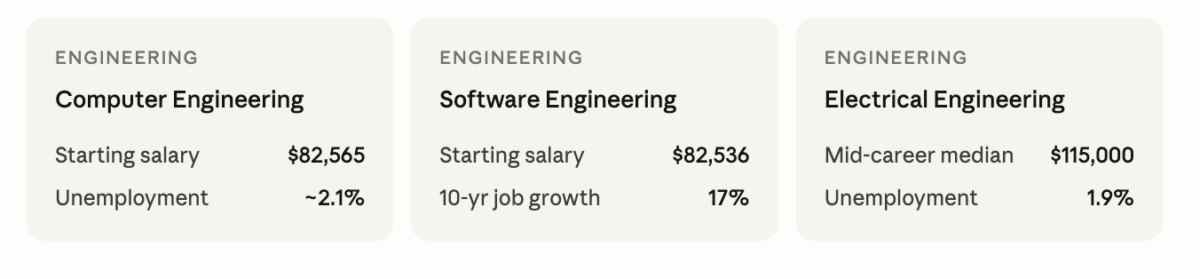
Bankrate’s major rankings name Electrical Engineering the single most valuable degree in America when you factor in both income and job security together. That 1.9% unemployment figure is basically as close to zero as labor economists expect to see.
Cybersecurity — the fastest-rising technical major
The BLS projects a 33% jump in information security jobs by 2033 — about eight times the average for all occupations. Median pay is already $120,360. The catch: there are not nearly enough people to fill the roles. Defense agencies, hospitals, banks, and utilities are all hiring. Cybersecurity graduates are entering a market where employers are actively competing for them, not the other way around.
Nursing — the safest bet in healthcare
Healthcare is the one sector that does not slow down in recessions. Nurses are the backbone of it. In 2026, nursing has a 1.42% unemployment rate — essentially everyone who graduates and wants a job has one. The BLS projects 8% annual growth and puts Nurse Practitioners among the fastest-growing occupations through 2034, at 40%.
“Essentially everyone who graduates and wants a job has one.”
A Bachelor of Science in Nursing (BSN) takes four years and leads directly to a licensed, in-demand role. In most parts of the country, new nurses are hired before they even graduate.
Physician Assistant Studies — high pay, faster than med school
PAs do a lot of what doctors do, in less time and with less debt. The BLS projects 28% growth through 2034 for the profession, driven by the same physician shortage that has pushed Nurse Practitioners into the spotlight. Median salary: $130,000. Unlike a medical degree, a PA program typically takes six years total from undergrad start to clinical practice.
Occupational Therapy — quietly one of the best bets

OT does not get talked about enough. Occupational therapists help people recover the ability to do everyday tasks after injury or illness — and as the population ages, that work is only growing. The BLS projects 12% growth through 2033, with a median salary of $96,370. It is a licensed profession, which means there is a built-in floor on competition and a clear credential employers recognize.
Finance — what employers are actually hiring
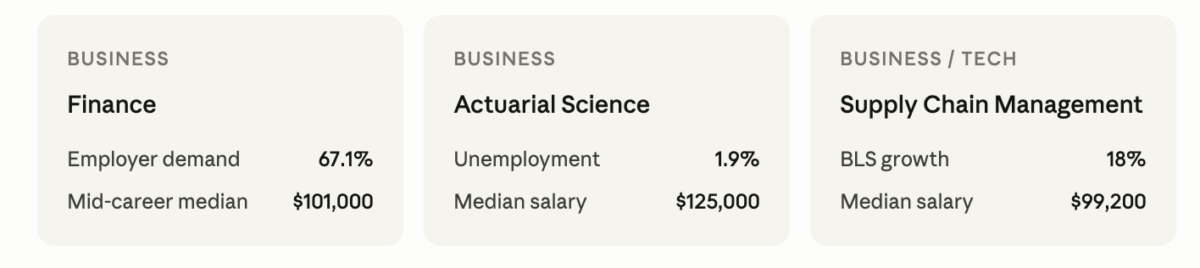
In business schools, finance is the one major where employer demand is concrete. Nearly 67% of employers surveyed by NACE said they planned to hire finance graduates — the highest of any business discipline. Mid-career median wages sit around $101,000. It is not glamorous, but the pipeline from classroom to cubicle is reliable and well-worn.
Actuarial Science — small field, near-zero unemployment
Actuaries calculate risk for insurance companies and financial firms. It is a niche field with a deliberately narrow credential pipeline — you have to pass a series of professional exams on top of your degree. That barrier keeps the supply of actuaries low. The result: a 1.9% unemployment rate and a median salary that climbs to $125,000 for experienced workers. If you are good at math and want job security, this is one of the clearest paths available.
Supply Chain Management — COVID changed everything
Before 2020, supply chain was a background function most people never thought about. Then global logistics collapsed and every company suddenly needed people who understood it. Hiring has stayed elevated since. The BLS projects 18% growth for logisticians and operations managers, with a median salary of $99,200. Companies that were burned by fragile supply lines are investing in this talent and paying for it.
Data Science — broad demand, built-in job security

The BLS projects a 34% growth rate for data science roles — one of the highest figures in the entire outlook. What makes data science particularly durable is how widely the skills apply. Healthcare systems need it. Sports franchises need it. City governments need it. Unlike some technical degrees that lock you into one industry, a data science major can go almost anywhere.
Applied Mathematics and Statistics — the quiet power major
Statistics does not have the brand recognition of data science, but Georgetown’s research on college major earnings consistently shows math-heavy degrees outperforming their peers over a career. Median wages for statisticians exceed $104,000, unemployment is below 2%, and the skills translate directly into the AI-adjacent roles that are driving hiring right now. Statisticians are not being replaced by AI tools — they are the ones building and auditing them.
Construction Management — the most AI-proof major on the list
Every degree on this list faces some risk from automation. Construction Management faces the least. The work is physical, local, and relational in ways that software cannot replicate. The BLS projects 9% growth through 2033, driven by the largest federal infrastructure investment in American history. Median salary: $104,900 — well above the national average for a four-year degree, with strong demand in virtually every metropolitan area.

The pattern across all twelve of these fields is the same. The degrees with the strongest outcomes give graduates something concrete on day one — a license, a hard skill, a credential that signals ability to an employer who has never met you. In a job market where “I have a degree” is no longer enough on its own, that specificity is what separates a good investment from an expensive gamble.
