

The World Bank has a stark message for the global economy this week: energy is about to get a lot more expensive, and the reason is war.
In its latest Commodity Markets Outlook, published on April 28, the Bank projects that global energy prices will surge 24% in 2026 — the sharpest spike since Russia invaded Ukraine in 2022. The trigger this time is the conflict in the Middle East, which has sent shockwaves through oil markets, shipping routes, and food supply chains all at once.

The immediate cause is the Strait of Hormuz, the narrow waterway through which roughly a quarter of the world’s seaborne oil trade passes. Beginning on March 4, Iranian forces declared the Strait “closed,” threatening and carrying out attacks on ships attempting to transit it. The effect on supply was near-immediate. The oil production of Kuwait, Iraq, Saudi Arabia, and the UAE collectively dropped by at least 10 million barrels per day within days of the closure — a reduction the IEA chief Fatih Birol described as the largest supply disruption in the history of the global oil market. Brent crude, which opened the year around $69 a barrel, briefly surged past $120 before moderating. The World Bank now expects it to average $86 a barrel for the full year — and warns it could climb to $115 if infrastructure damage worsens.
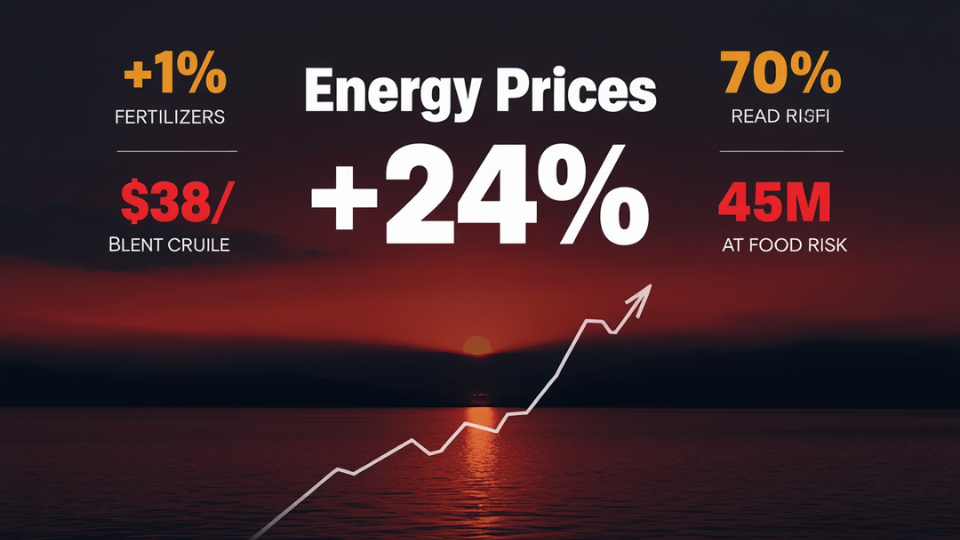
The 24% energy inflation figure is the headline, but the report’s more troubling finding is how far the damage spreads. Fertilizer prices are expected to jump 31% this year, driven by a 60% rise in urea costs. That matters because fertilizers feed farming, and farming feeds people. The World Food Program estimates that if the conflict drags on, up to 45 million more people could fall into acute food insecurity before the year is out. Metals, including aluminium, copper, and tin, are on course for record highs. Precious metals are forecast to rise 42% as investors chase safe-haven assets. Overall commodity prices, taken together, are expected to rise 16% in 2026.
For developing economies, the compounding effect of all of this is severe. Inflation in the developing world is now projected at 5.1% for the year — a full percentage point above what analysts were expecting before the war began. Growth has been revised down to 3.6%. The World Bank notes that 70% of commodity-importing nations and more than 60% of commodity-exporting nations will likely see weaker economic performance than forecast just three months ago.
World Bank Chief Economist Indermit Gill put it plainly: “The war is hitting the global economy in cumulative waves — first through higher energy prices, then higher food prices, and finally, higher inflation, which will push up interest rates and make debt even more expensive.” He added: “War is development in reverse.”
One thing the report makes clear is that even if the conflict eases soon, the inflationary pressure it has created will not simply dissolve. The Bank’s own analysis shows that geopolitically driven oil shocks ripple into gas and fertilizer markets with a lag of up to a year. The world may stop hearing about the Strait of Hormuz on the news long before it stops paying for what happened there.
