

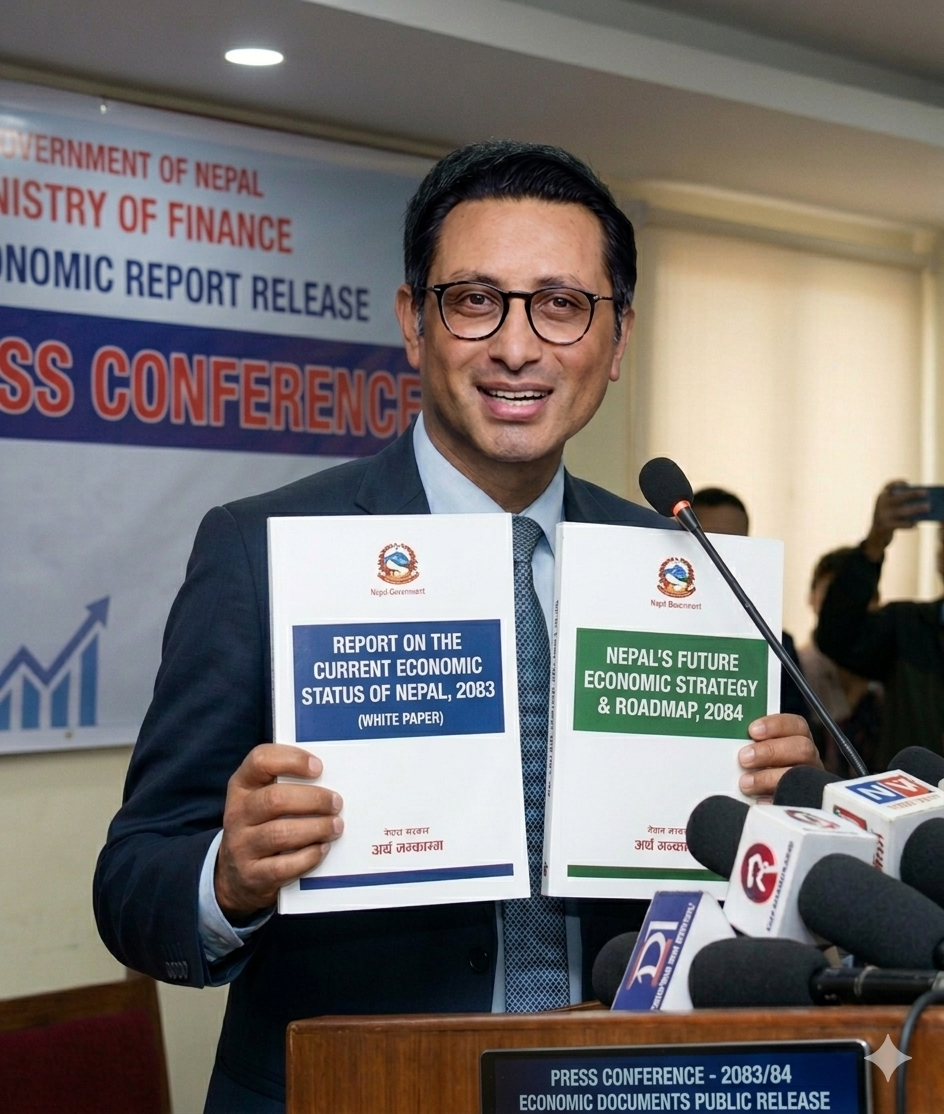
The Government of Nepal has issued the ‘Report on the Current Economic Status of Nepal, 2026’ (White Paper). This report presents a realistic picture of the country’s economy through 73 key points.
Finance Minister Dr. Swarnim Wagle released this status paper on the 31st day of the new government’s formation. Upon taking office, he had promised to bring the “real mirror” of the economy before the public.
The government stated that this report was brought forth to understand the actual state of an economy crippled by past policy corruption, “crony capitalism,” and weak implementation, and to make upcoming budgets and policies more realistic. It not only identifies economic problems but also presents a roadmap to make Nepal a $100 billion economy within the next 10 years.
We have summarized the main highlights of this report through 10 questions and answers.
1. What is the current trend of Nepal’s economic growth?
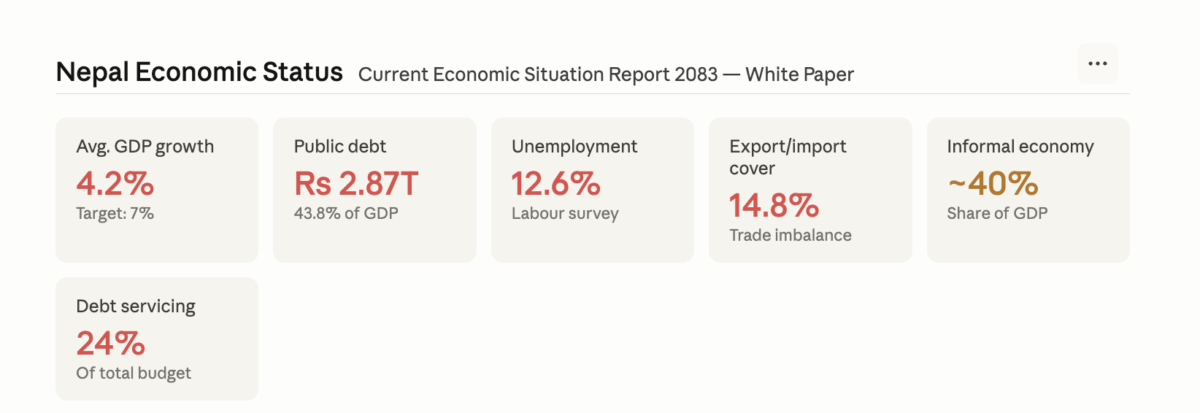
For the past decade, Nepal has been trapped in a cycle of low economic growth, averaging 4.2%. During this period, the economy saw a minimum contraction of 2.4% and a maximum expansion of nearly 9%. For 2026, growth is projected to be around 3.5%, primarily due to a decline in domestic demand. This growth is considered very slow compared to neighboring countries.
2. What is the status of foreign aid and public debt?
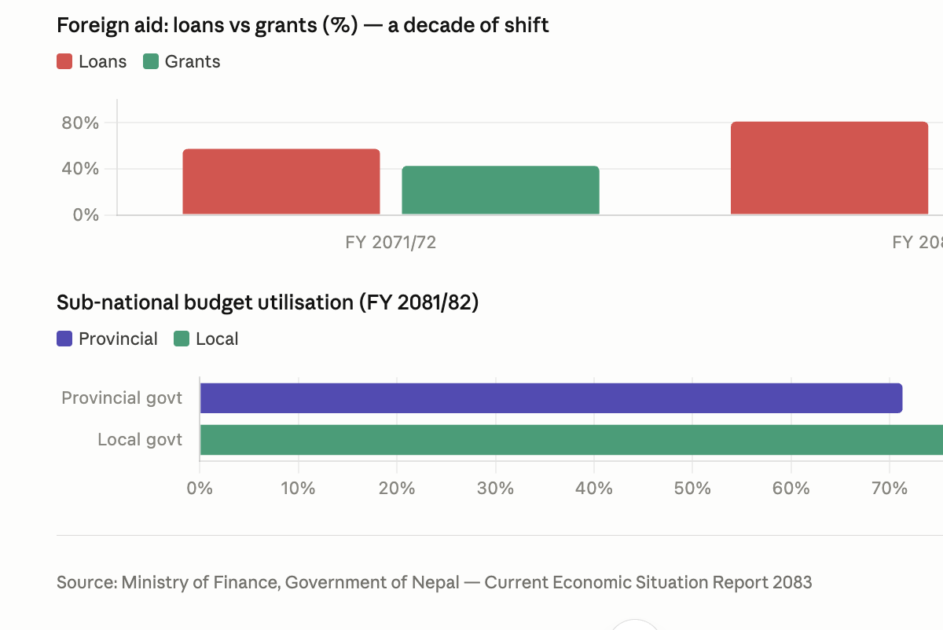
Previously, ‘grants’ made up a large portion of foreign aid, but now the burden of ‘loans’ has increased. The grant component has shrunk from 42% ten years ago to just 19% today. By mid-March 2026, Nepal’s total public debt reached Rs 28.78 trillion, equivalent to 43.8% of GDP. The main risk now is the “borrowing to pay back debt” situation. A large portion of the budget is spent on principal and interest repayments rather than development; nearly one-fourth of the national budget is consumed by debt servicing. As Nepal prepares to graduate from ‘Least Developed Country’ (LDC) status, concessional aid is at risk of further decline, likely increasing the state’s debt burden.
3. Why isn’t the development budget (capital expenditure) spent as targeted?
On average, only 60-65% of the allocated development budget is spent. Even then, the “Asare Bikas” (end-of-fiscal-year spending rush) trend weakens the quality of expenditure and hinders long-term infrastructure. Over the last decade, capital expenditure has averaged only 19% of total federal spending. The failure of many economic policies is attributed to weak implementation capacity, limited financial resources, poor prioritization, and inefficient resource allocation.
4. Is Nepal’s revenue system sustainable?
No. The revenue system is heavily dependent on imports. Remarkably, 51% of total internal revenue is paid by only 100 large taxpayers. Over the last five years, the average revenue growth rate has been only 8.7%. The large size of the informal economy has narrowed the tax base. Since a significant portion of revenue relies on imports and consumption, the revenue base derived from domestic production is very weak.

5. What changes have occurred in the trade balance?
Trade imbalance remains a major problem—exports cover only 14.8% of imports, highlighting an extreme dependence on imports. Even within those limited exports, 42% is concentrated in the re-export of edible oils, which offers minimal domestic value addition. However, the overall external sector balance is maintained due to remittance income.
6. What is the status of employment and foreign labor?
Remittances have kept the economy from collapsing, but they are spent more on consumption than on production. Ongoing conflicts in West Asia have increased the risk that this primary source of remittance could be affected at any time. Due to limited domestic opportunities, dependence on foreign employment is rising. The unemployment rate stands at 12.6%. In FY 2081/82, 839,000 Nepalis took labor permits, and 557,000 have already taken them by mid-April of the current year. While remittances support the economy, the report notes a growing risk of “human capital erosion” in the long run.
7. What structural weaknesses are seen in Nepal’s economy?
The White Paper concludes that Nepal’s economy is shifting toward the service sector without first undergoing industrialization from agriculture. The contribution of the agricultural sector dropped from 28.4% in FY 2072/73 to 25.2% in 2081/82. Meanwhile, the service sector grew from 57.5% to 62%, while the industrial sector’s share shrank from 14.1% to 12.8%. This indicates a state of “premature deindustrialization.”
8. What is the economic aspect of federalism implementation?
The spending capacity of provincial and local levels is weak. They depend on central grants for more than 90% of their spending, yet they cannot fully utilize the allocated budget. Since the implementation of fiscal federalism, 22.6% of the total federal budget is allocated for financial transfers, and about 11% of revenue is transferred through revenue sharing. Despite these resources, in FY 2081/82, the budget utilization capacity of provinces and local levels was only 71.3% and 76.4%, respectively, due to limited technical and managerial capacity. Furthermore, their contribution to total revenue collection is less than 10%, meaning they remain dependent on the center while failing to stimulate demand or development through the funds they do receive.
9. What is the impact of the informal economy?
Nearly 40% of Nepal’s economy remains outside formal mechanisms. This results in the government losing actual tax revenue and creates confusion in policy-making. The report estimates that the informal economy is about 40% of the GDP, narrowing the tax base. Consequently, 45% of total tax revenue is import-based, and a large portion of taxpayers fail to file regular tax returns. This means half the economy operates outside government statistics, making it difficult to get an accurate picture for reforms.
10. What goals and visions does the White Paper hold for economic reform?
The White Paper points out that the only options left are to cut unnecessary administrative spending, fully digitize the tax system, and pivot the consumption-oriented economy toward production (specifically hydropower and IT).
The Ministry of Finance states that an average 7% economic growth can be achieved starting next fiscal year. The goal is to cross a per capita income of $3,000 and reach a $100 billion economy within the next 5 to 7 years. To achieve this, the report proposes:
- Reaching 15,000 MW of electricity production capacity within 5 years.
- Completing National Pride Projects within 2 years.
- Strengthening the links between agriculture, industry, and tourism.
- Expanding the digital economy.
- Identifying Artificial Intelligence (AI), robotics, IT services, BPO, and digital entrepreneurship as the primary opportunities for the coming decade.
